Purpose and location
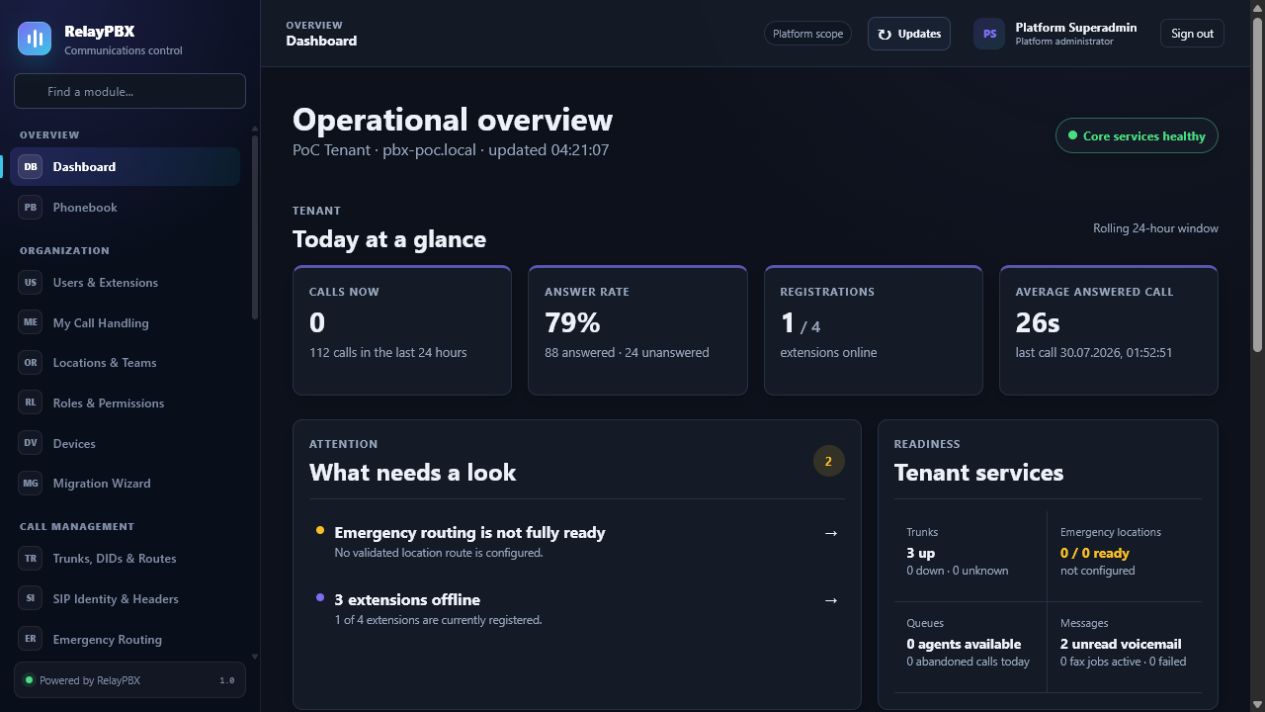
Read service health, tenant capacity, call activity and operational warnings.
Open Overview → Dashboard. The available controls depend on the active edition, module entitlement, role and tenant scope.
Before you start
No configuration change is required to read this screen. Confirm the selected tenant or platform scope and the time zone before interpreting live state.
Capture the current value or export the affected records before a bulk or routing change. This gives the operator a precise comparison point and makes a supported transaction undo easier to assess.
Step-by-step workflow
Complete the steps in order. Do not combine an initial configuration with unrelated cleanup; small, attributable changes are easier to test and reverse.
- Confirm the active scope and time range.
- Open warning cards before changing call configuration.
- Use module shortcuts to reach the source record.
Field reference
Use the reference below while completing the form. Fields hidden by edition, module entitlement or role are intentionally unavailable to the signed-in user.
- Scope
- Platform-wide for a superadmin or tenant-only for delegated administrators.
- Live calls
- Current bridged, ringing and queued calls.
- Registration health
- Registered devices compared with provisioned endpoints.
- Alerts
- Active and acknowledged operational conditions requiring review.
Acceptance checks
A saved record is only the beginning of validation. Run every relevant check below and retain the call-session ID, time and result when telephony is involved.
- Open every active warning and confirm that it points to the responsible module.
- Compare registrations and live-call counters with one known endpoint and test call.
Common mistakes and safe recovery
If a check fails, stop adding changes. Restore the previous value or use a supported transaction undo, regenerate PBX configuration, then repeat the smallest failing test.
- A healthy summary does not replace an acceptance call after routing, media or carrier changes.
What to include in a support case
Provide the tenant, module and object name, local time with timezone, expected result, observed result and the most recent successful state. For a call problem, include the logical call-session ID and the redacted SIP/SDP text diagnostic before requesting PCAP.
Never paste passwords, private keys, raw license payloads or unredacted customer media into a ticket. Use the one-time diagnostic grant and attachment controls when support requests additional evidence.