Purpose and location
Connect carriers and route inbound and outbound traffic to every supported PBX endpoint.
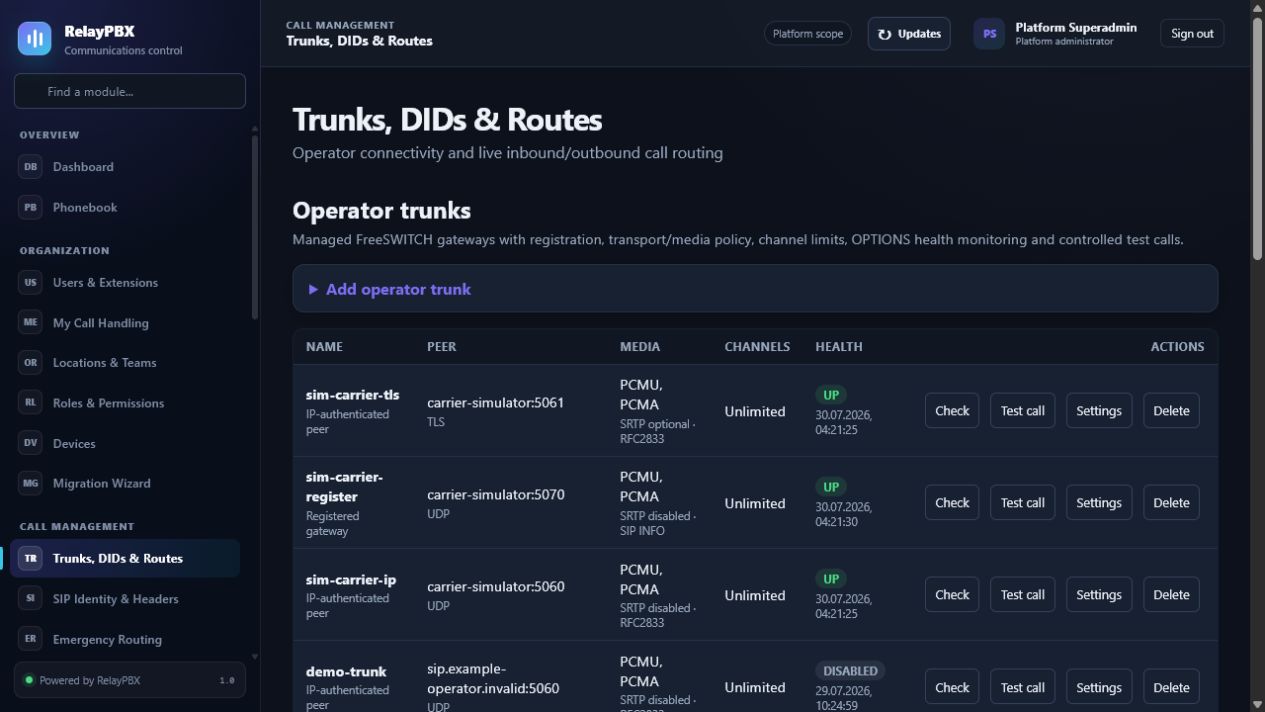
Open Call management → Trunks, DIDs & Routes. The available controls depend on the active edition, module entitlement, role and tenant scope.
Before you start
Write down the current source and destination path before editing it. Keep a registered test extension, a rollback destination and Calls & Reports open for validation.
Capture the current value or export the affected records before a bulk or routing change. This gives the operator a precise comparison point and makes a supported transaction undo easier to assess.
Step-by-step workflow
Complete the steps in order. Do not combine an initial configuration with unrelated cleanup; small, attributable changes are easier to test and reverse.
- Create and validate the trunk.
- Add DIDs in canonical format.
- Map inbound numbers to extensions, IVRs, time conditions, groups, queues, fax or other services.
- Order outbound routes from specific to general and test failover.
Field reference
Use the reference below while completing the form. Fields hidden by edition, module entitlement or role are intentionally unavailable to the signed-in user.
- Authentication
- Registration, credentials or trusted source IPs.
- Transport and proxy
- Carrier signaling endpoint, port and protocol.
- DID destination
- PBX endpoint receiving an inbound number.
- Pattern
- Outbound number rule and optional prefix manipulation.
- Priority
- Evaluation order for routes and failover trunks.
- Channel limit
- Configured concurrent-call ceiling.
Acceptance checks
A saved record is only the beginning of validation. Run every relevant check below and retain the call-session ID, time and result when telephony is involved.
- Run OPTIONS or registration health and keep one successful carrier response.
- Place inbound and outbound calls, verify two-way audio and hang up from each side.
- Force the primary trunk unavailable and confirm ordered failover without changing the presented identity.
Common mistakes and safe recovery
If a check fails, stop adding changes. Restore the previous value or use a supported transaction undo, regenerate PBX configuration, then repeat the smallest failing test.
- A green trunk state proves signaling reachability, not correct media, identity or emergency behavior.
- Use example.invalid and simulator records only in non-production environments.
What to include in a support case
Provide the tenant, module and object name, local time with timezone, expected result, observed result and the most recent successful state. For a call problem, include the logical call-session ID and the redacted SIP/SDP text diagnostic before requesting PCAP.
Never paste passwords, private keys, raw license payloads or unredacted customer media into a ticket. Use the one-time diagnostic grant and attachment controls when support requests additional evidence.